
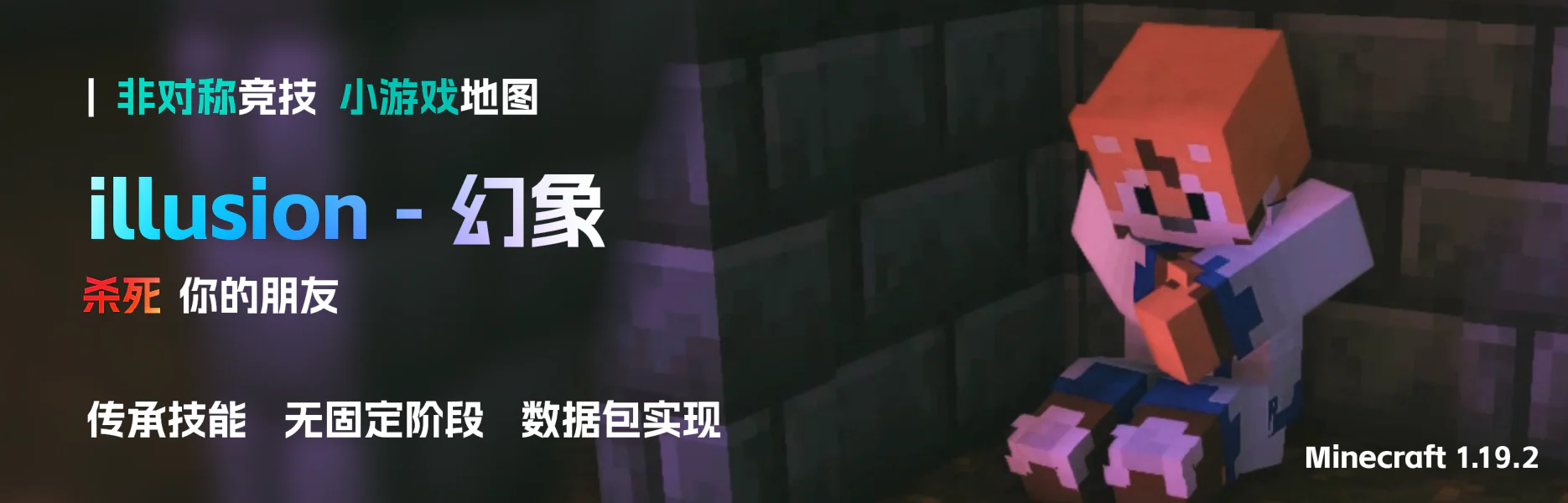
illusion is a Minecraft map I develop with a friend, combining two long-running interests of mine: Minecraft and asymmetric multiplayer games. Survivors collect coins, complete offerings, and bring candles to the exit. The killer tracks and captures them before they can escape.
Earlier maps
My first attempt began in April 2019 on Minecraft 1.12.2, under the name Bi An Hua Kai. It followed Dead by Daylight more closely, with a separate health system, downed players, hooks, and Ender Eyes placed in an End Portal to stand in for generator repairs. That project stopped, but contributing items toward a shared objective survived into later versions.
In 2021 I met another player experimenting with similar mechanics. We made a Bedrock Edition map together, casually named NetEase Tag. It already included experiments with random map sections. The world save was later lost, followed by several unsuccessful restarts.
On September 14, 2022, we started again on Java Edition 1.19.2 and called the map illusion. We kept vanilla health, removed the downed and hook systems, and sent defeated survivors straight to a cage. Those simpler rules became the basis for the later game.
A match
Survivors gather coins near them and deposit them in seven offering chests. Completing an offering gives one nearby survivor a candle and briefly highlights the chest across the map. Once survivors leave its vicinity, it recovers and can be used again. A killer approaching a recovering chest pushes that recovery back. Coins near the killer disappear too.
The offering rate adjusts as players are eliminated: each remaining survivor contributes faster. An exit requires eight candles, split equally between two stands. Once supplied, survivors must remain nearby until its opening progress finishes; the killer can reverse that progress by entering the area.
Defeated survivors are sent to cages with a growing elimination meter. First capture, passing halfway, and elimination form three stages. Being rescued and captured again advances directly to the next stage. Rescue decisions compete with collecting candles and opening the exit.
Tracking uses white footprint particles visible only to the killer. Standing survivors leave markers, while crouching suppresses them. I implemented those markers as effect-free area-effect clouds lasting five seconds, then spawned particles at their positions, with more emphasis on nearby tracks.
Map sections and spawning
The arena is assembled by copying prebuilt sections according to generation rules. Individual sections retain their internal layout while their combinations change between matches.

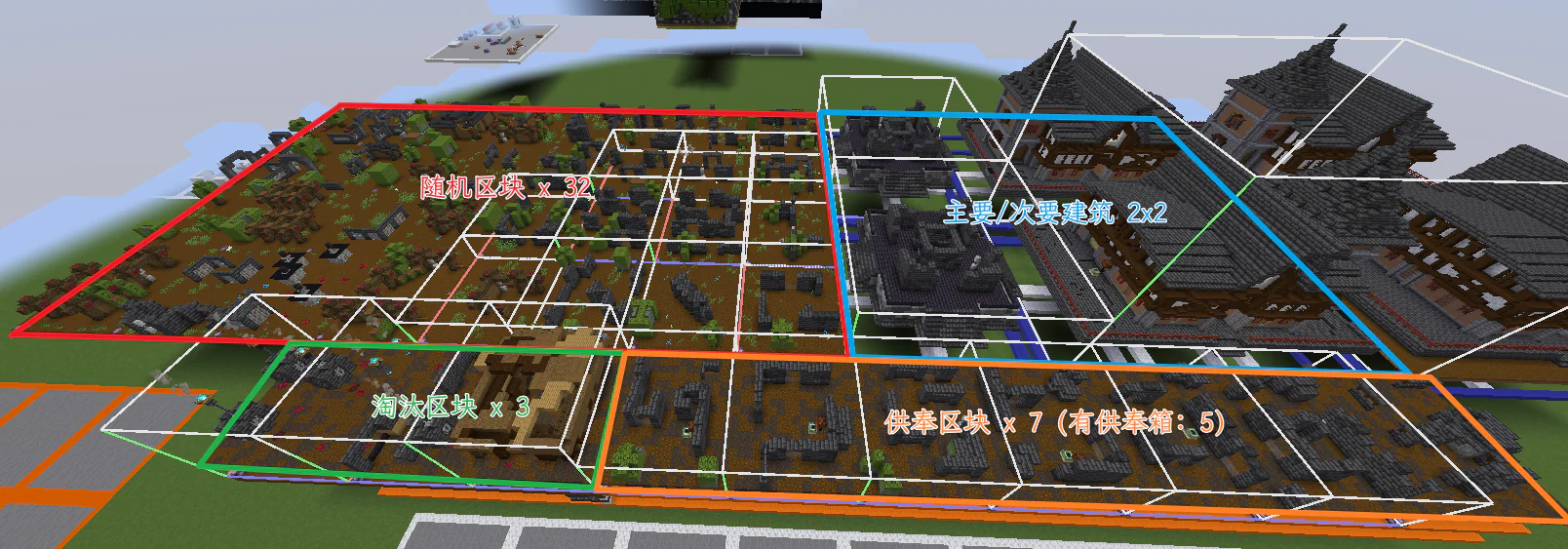
Spawn selection follows the generated map. A random reference point becomes one survivor's spawn. The farthest point is assigned to the killer, and three nearby points more than 32 blocks from the reference are selected for the other survivors. This uses vanilla target selectors.
Map-generation development notes
Datapack implementation
I organized much of the match logic around recurring functions, handlers, and timers. A scheduled function calls itself again for repeated checks. Events invoke their corresponding handlers, giving skills and player-state changes common places to attach their behavior.
Timers combine those recurring functions with scoreboard values for the remaining time. Skills use the same event-driven arrangement.
The ready-area counter needed an unusual workaround. Armor-stand names could not directly interpolate a variable, so I wrote the player count into a sign's text, then copied its text NBT into the floating label.
Escapes and eliminations trigger the result check. When no survivors remain freely active in the arena, the game compares the number who escaped with the number eliminated to determine a survivor win, killer win, or draw.
Characters and tutorials
Version v0.4.3-beta had four killers and eight survivors. The killers are Plague Doctor, Gardener, Weeping Angel, and Hunter, each with a distinct power. Characters also start with three teachable skills. Playing a character unlocks those skills for other characters, with up to four equipped in a match.
A separate tutorial walks players through the controls and match rules.
Website and videos
I also built the Nuxt website, using a full-screen video in its opening section, and produced several promotional videos. They begin with Minecraft animation, then introduce the map or character mechanics.