
Oldtown Puzzle was an offline puzzle event I helped create and run with friends. Xiaoguaishou a led the writing and contributed to planning. Jin Shisan also wrote and planned the story. I worked on planning and built the website.
The week before the event, Jin Shisan and I had made Bible Puzzle as a short experiment, linking clues on paper to puzzles on a website. Oldtown had a script of roughly ten thousand Chinese characters, with more interactive puzzles woven into the story.
Scan the code, join the expedition
Players entered the website by scanning a QR code on the event's opening puzzle. They first saw a conversation resembling a new WeChat contact, then joined an expedition to an old town. They could tap through the dialogue, stop to solve a puzzle, and return to the story once they had an answer.
I kept the dialogue and interaction in one chat interface. Characters, narration, and player replies each had their own position. Buttons and answer fields appeared within the conversation, so players could follow it through the event.
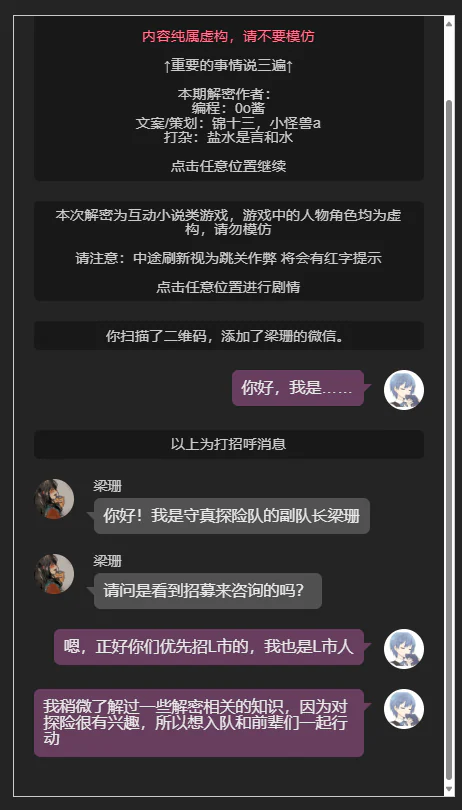
Turning the script into a playable sequence
The script arrived without a fixed format. I converted it into a story configuration, matching characters and message order with the points that needed player input. This took a substantial part of the work: where a conversation stopped, when a puzzle appeared, and which line followed a correct answer all needed to be arranged in the program.
Using Vue 3 and TypeScript, I built message components for buttons, input fields, player dialogue, NPC dialogue, and system messages. The story configuration selected the components. Dialogue could advance on a tap, while a question waited for the submission result before continuing.
The puzzles called for different actions. Players entered keywords found in a text, dragged nine stone tiles into a bagua diagram, or clicked hand signs in sequence. I built the tile puzzle with Vue Draggable Next and CSS Grid; the message components handled entering a puzzle and returning to the conversation.
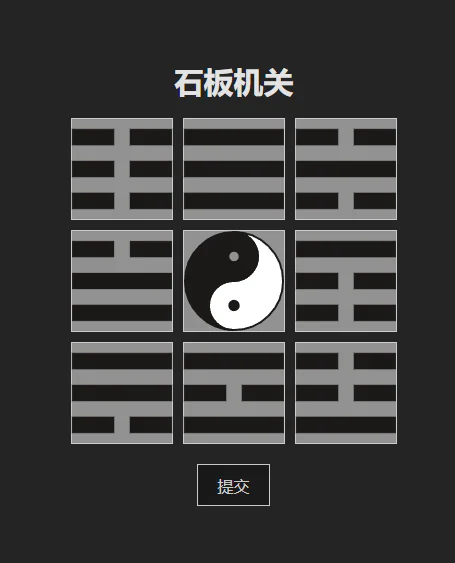
When players got stuck
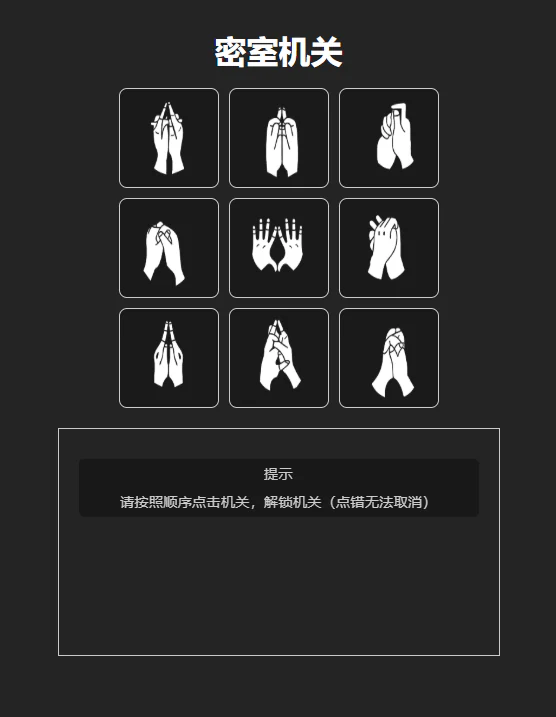
Players at the event would not necessarily solve every puzzle. One mechanism asked them to click nine hand signs in a particular sequence. After three failed attempts, an NPC guided them through it so they could reach the next part of the story.
I saved progress with Vuex and local storage. Some stages checked prerequisite progress and displayed a warning at the top of the page when the state was inconsistent. The game ran entirely in the browser and was deployed on Vercel.
Looking back after the event
Playing the game exposed problems in the puzzle design. Several versions of the bagua diagram exist, but I had prepared only one accepted arrangement. The poem on the stone wall stopped quite a few players, while an easier old-text puzzle came later.
The easier old-text puzzle should have appeared earlier, and the bagua puzzle needed to accept other valid versions of the diagram.
The development notes retain the individual puzzles, implementation examples, and Jin Shisan's discussion of the characters and story.