
We had tried putting OpenClaw directly into a group chat. It replied to almost everything, including conversations people were having with one another. A reply could be reasonable on its own and still feel intrusive in context.
Spock is my resident Feishu agent: it can join a conversation, collect daily reports, and take tasks. I have spent a lot of time deciding when it should speak.
Who was “it comes from Star Trek” addressed to?
During testing, someone wrote that a name came from Star Trek. Spock treated the message as a follow-up to itself, although it was a reply to another person. Having participated in a topic does not make every subsequent message part of the agent's conversation.
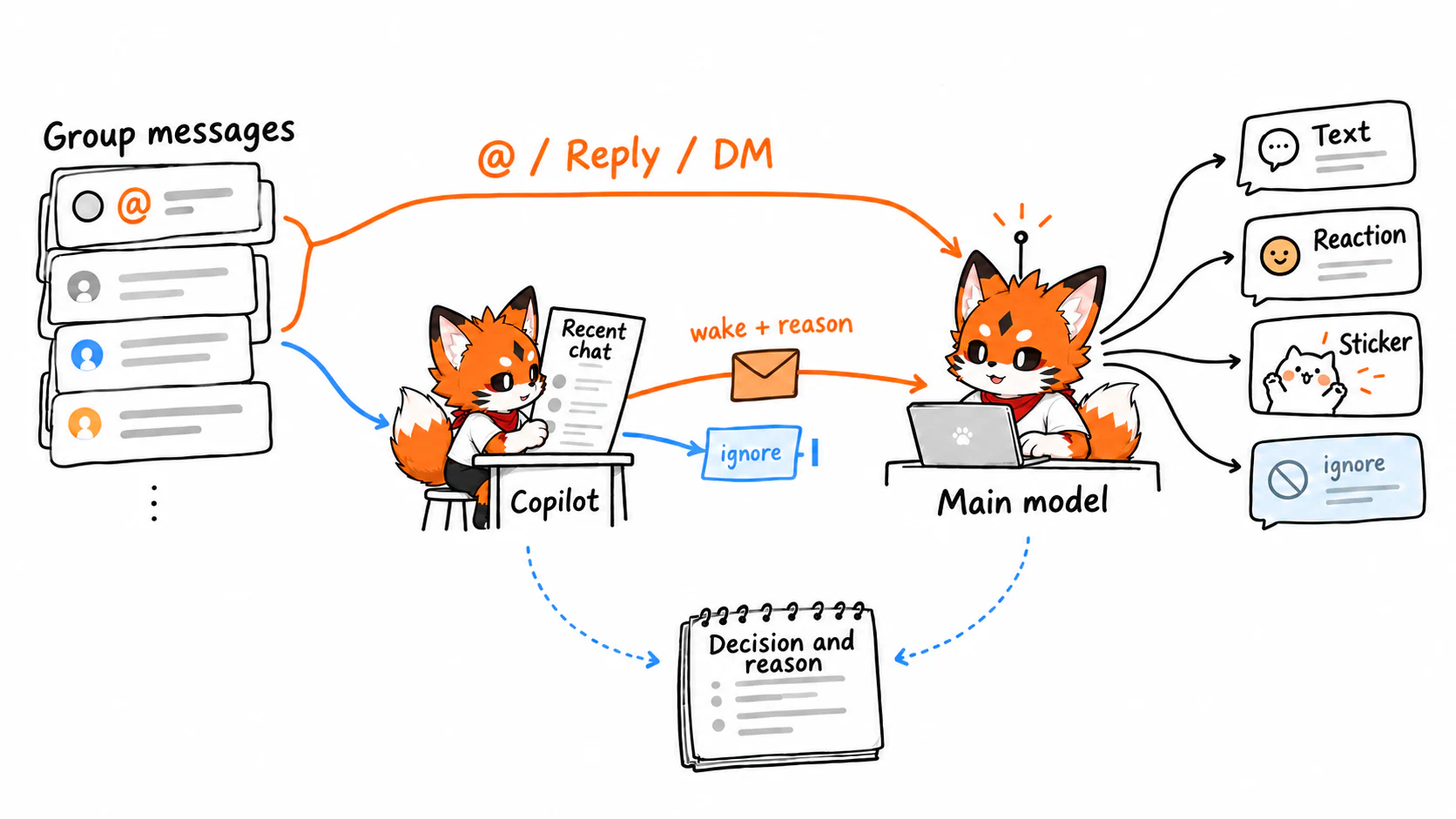
Restricting replies to explicit mentions would miss names, follow-ups, and images. I split the trigger paths instead: an explicit @mention, direct reply, or private message wakes the main model through program rules; ordinary group messages first go to a cheaper Copilot model to decide whether participation makes sense.
Copilot sees recent messages, the current batch, Spock's last speaking time, and a short group state. Messages that do not wake the main model still enter the recent-message buffer, so the next decision has more than the context of its previous reply.
The initial decision was only wake or ignore. I later added a reason, both to explain the wake-up to the main model and to investigate mistaken interruptions.
Silence needs an explicit outcome
The main model can still choose silence after being woken. Its ignore(reason) tool records that choice without sending anything to the group.
Generating internal text without calling a sending tool also produces no visible message, but it is a different runtime outcome. Each turn therefore needs an explicit action: send a message, add a reaction, send a sticker, or ignore.
Typing status now starts from a non-ignore tool action. Starting it as soon as the model runs can leave group members watching “typing” before the agent decides not to reply.
Wake reasons, ignore reasons, and performed actions are logged separately. When a reply is missing or unwelcome, those records show where that turn went wrong.
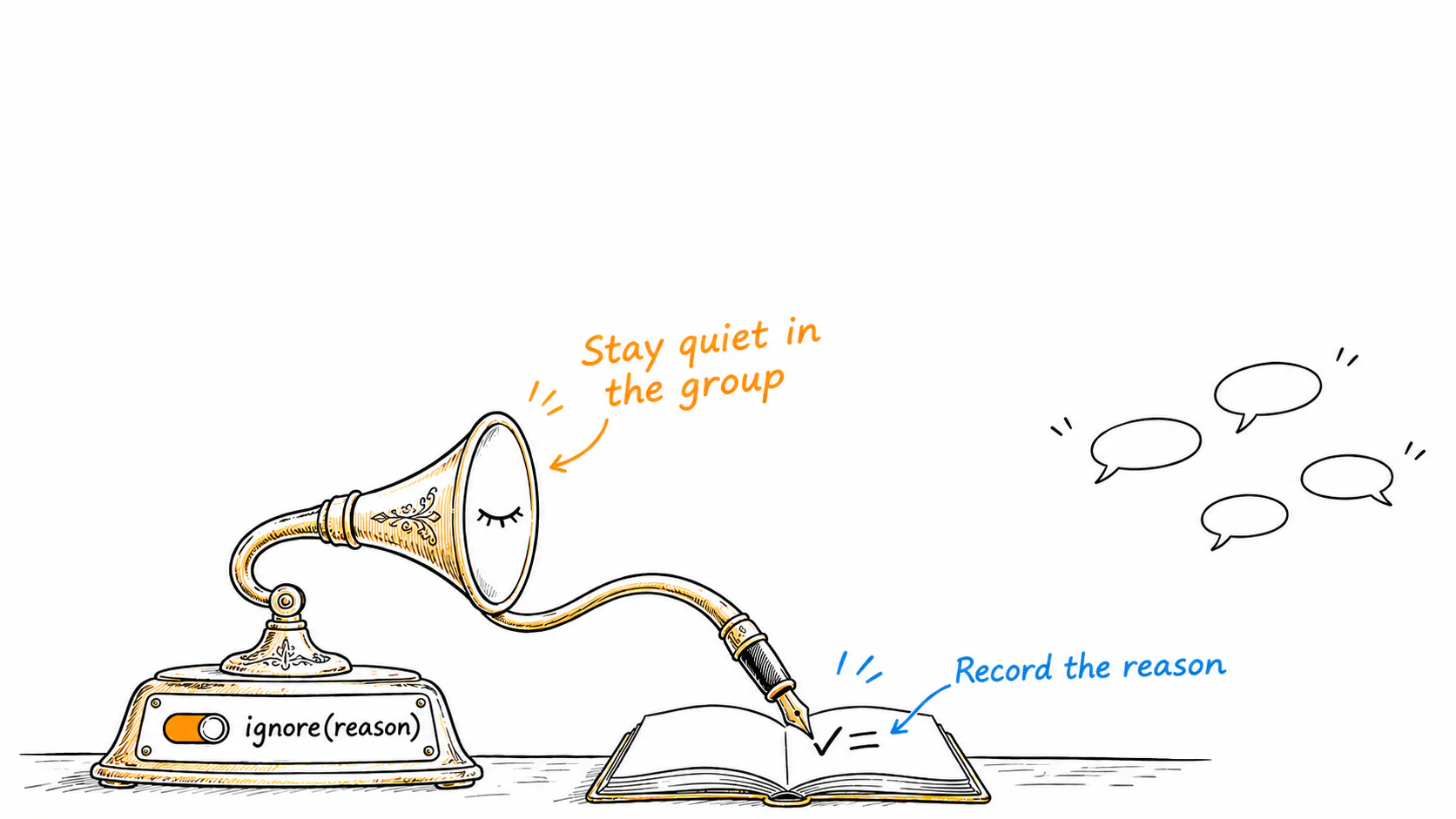 ignore records a reason for staying silent and completes the turn
Borrowing the group's stickers
Spock can save received stickers and descriptions, then search and send them later. Image descriptions are cached by resource identity. Sending first searches the collected library and checks that the requested resource exists.
Spock can add a received image to the library without replying with a sticker.
Images also revealed a wake-up bug. Copilot originally saw only text, making an image-only message look nearly empty. It could ignore the message before the main model ever saw the image. I moved image description before the wake decision, shared it with both models, and bounded the wait so one image would not hold up the batch indefinitely.
In group tests, a sticker worked better than a paragraph for some teasing exchanges. Short text still matters, though. I asked why it could never say something as brief as “I'll take a look.” A short acknowledgement that work is starting and a lengthy narration of work are different things.
Tasks and memory
Feishu events arrive over WebSocket, and actions go through a tool layer. Reading and summarizing can proceed directly; execution requiring authorization asks the owner and can wait without blocking the main loop. Skills carry particular jobs such as opening issues, while the core handles platform access, context, and authorization.
Each group has its own session and memory. Older messages retain source pointers for later retrieval. Cross-group information is checked for disclosure scope before entering another conversation. Later work added topic awareness, background read-only tasks, and scheduled instructions.
I am still correcting cases where Spock mistakes the addressee, continues an old topic, or replies at excessive length in a group conversation.